Sunday, January 9, 2022

Frank Algernon Stewart (1877-1945) - British artist


With thanks to Ognyan Hristov for discovering this amazing artist who was also a war correspondent during the Boer War.


Frank was born in Croydon, UK on 16th October 1977.  His parents were Ebernezer Stewart, a seed crusher, and his wife, Mary Ann Stewarat, nee Betts.    Educated in Hastings, Frank studied art under George Ward in Rochester, Fred Brown at the Slade, and Frank Calderon at the School of Animal Painting. Frank became a war artist for “The Illustrated London News” and in October 1899 went to Africa where he saw action at Colenso, Spin Kop, Monti Christo and the releif of Ladysmith during the Second Boer War.

Invalided home, Frank went to Paris in 1901, to study at the Académie Julian with Rodolphe Julian.  In 1903, he married Eliza Jane Brown in Havant, Hampshire.  The couple lived in Croydon but Eliza Jane died in December 1905.   

Sketch by Frank of General Buller riding in to greet General White outside the Town Hall in Ladysmith - 28 February 1900   Sketched in situ by Frank Algernon Stewart, the official Boer War artist of the London Illustrated News who came to South Africa in October 1899.


The Surrey Yeomanry on the Struma Valley Front, Salonika 1917-1918. The Evening Wireless - Komarjan Bridge. By Frank Algernon Stewart .


During the First World War, Frank served in the King Edward's Horse, Norfolk Yeomanry. Frank was a keen huntsman and his work was predominantly of hunting scenes. In later life he was forced to give up hunting as the result of an operation, but he continued to follow the hounds on foot, making sketches of hounds running.

By 1939, Frank had re-married and he and his wife, Muriel Winifred, lived in Cheltenham in Gloucestershire, where he died in June 1945. 

NOTE:  The Académie Julian was a private art school for painting and sculpture founded in Paris, France, in 1867 by French painter and teacher Rodolphe Julian (1839–1907) that was active from 1868 until 1968. The Academy remained famous for the number and quality of artists who attended during the great period of effervescence in the arts in the early twentieth century.  After 1968, the Academy integrated with ESAG Penninghen.

William Frank Calderon and Charles Edward Johnson, a landscape artist, started the School of Animal Painting at 54 Baker Street, London in April 1895 and Frank Calderon was the school’s Principal until 1916.


Thursday, January 6, 2022

Percy Hague Jowett (1882–1955) was a British artist who became Principal of the Royal College of Art

Found by Ognyan Hristov


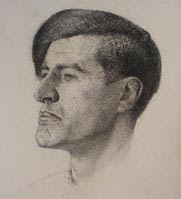
 Portrait by Peter Coker 

Percy was born in Halifax, Yorkshire, UK on 1st June 1882.  His parents were Smith Jowtt, a schoolmaster, and his wife, Lucinda Georgina Jowett, nee Hague, who was a schoolmistress.  Percy has a sister, Gertrude, who was born in 1885. 

He studied art at Leeds College of Art and London's Royal College of Art.

In September 1912, Percy married Enid Ledward, sister of the sculptor, Gilbert Ledward.

During the First World War, Percy served in the Royal Garrison Artillery, first as a Corporal then as a Second Lieutenant.

In 1927, Percy became head of Chelsea School of Art, and in 1935, principal of the Royal College of Art, succeeding William Rothenstein, and went on to give the sculptor Henry Moore his first job.  

During the Second World War, Percy served as a committee member with the War Artists' Advisory Committee. He retired from the RCA in 1948.

“England, Triptych” by Percy Jowett, First World War. circa 1918

Sources: Find my Past, Free BMD 

https://www.facebook.com/groups/385353788875799

Portrait of Howett - Percy Hague Jowett (1882–1955) by Peter Coker (1926–2004)

A triptych is an artwork made up of three pieces or panels. 


Alfred Basel (1876-1920) - Austrian artist and etcher

Alfred Basel was born on 23 March 18 in Vienna. His father was a factory owner. Alfred studied at the Wiener Kunstgewerbeschule under Felician von Myrbach between 1892 and 1898. 

He was a reserve officer during the First World War, serving with the rank of Oberleutnant in the Fourth Army on the Galician Front from March 1915. In the autumn of that year, Alfred became ill and was declared unfit for military service. By November 1915, he had been appointed to serve as a war artist serving the Kriegspressequartier. In 1916 he was on the Vistula, in the Carpathians, in Albania, on the Isonzo, and in the Ukraine. It was his artistic breakthrough.


In 1919, at the winter exhibition of the Wiener Künstlerhaus, Basel exhibited his work outside of the Kriegspressequartier for the first time. His treatment of military events was careful and accurate, and both stylistically and biographically he has many similarities to Oskar Laske. Like him, Basel avoids sensationalising or exaggerating, and favours crowds of small figures and a simplicity approaching photographic accuracy.

Alfred died on 24 January 1920 from the effects of a hunting accident in Dickenau, Türnitz, Lower Austria.


Saturday, November 27, 2021

Norah Neilson Gray (16 June 1882 – 27 May 1931) - Scottish artist

Nora Neilson Gray
Self Portrait, 1918
Born in Helensburgh in 1882, Nora's p arents were George Gray, a Glasgow ship owner, and his wife, Norah Gray, nee Neilson. 

During the First World War, Norah volunteered to serve with the Scottish Women's Hospitals and was sent to France..  As you can see, Nora managed to find time to paint and sketch. She offered a painting entitled “Hôpital Auxilaire 1918” showing the SWH Hospital in Royaumont Abbey to the Imperial War Museum but the Women's Work Sub-committee of the Museum refused to accept it and requested a painting showing a woman doctor instead.  

Shown below is Norah’s second painting of Royaumont Abbaye, entitled “The Scottish Women's Hospital In The Cloister of the Abbaye at Royaumont - Dr Frances Ivens inspecting a French patient” was accepted by the IWM in 1920.


Royaumont Abbey is a former Cistercian abbey, located in northern France near Asnières-sur-Oise in Val-d'Oise, approximately 30 km north of Paris. From January 1915 to March 1919 the Abbeywas used as a voluntary hospital – L’Hôpital Auxiliaire 301 – which was operated by The Scottish Women's Hospitals(SWH), under the direction of the French Red Cross. It was especially noted for its performance treating soldiers involved in the Battle of the Somme. After the war, the Chief Medical Officer, Dr Frances Ivens CBE MS(Lond) ChM(Liverp) FRGOG (1870–1944), was awarded membership of the French Légion d'honneur.


Thursday, November 4, 2021

Nellie Issac (1886 – 1955) - artist

With thanks to Historian Debbie Cameron for discovering Nellie for  us

Nellie Elizabeth Isaac was born in 1886 in Hampstead, London, UK, the birth being registered in the third quarter of that year. Her father, Percy Lewis Isaac, was a naval architect and marine engineer. Her paternal Grandfather was the Liverpool artist and lithographer John Raphael Isaac (1809 – 1870), who became medallist to Prince Albert. Her mother – Florence Maud Isaac, nee Alexander – was born in Clapham.   John Raphael Isaac did commercial work for some of the major shipping companies - Holt Shipping Line and the White-Star (Packet) Line (Liverpool-Melbourne). These commissions could explain how his son Percy became a naval architect and shipbuilder.

Nellie’s siblings were Rose Amelia, who also became an artist, and John Robert. According to the 1901 Census, the family lived in Dennington Park Road in West Hampstead. By the 1911 Census Nellie and her sister were both living with their parents, with their occupations listed as artists.

A Performance in the factory Canteen
Theatre

During the First World War, both Nellie and Rose Isaac gave up their art and design business and worked in the factory of Gordon, Watney and Co., Aeronautical Engineers, in Weybridge, Surrey fro two years. 

The factory specialised in the repair and overhaul ofmotor vehicles. The factory’s wartime production included aeronautics and munitions and the factory also worked with the Canadian army in refurbishing some of their vehicles.

The Imperial War Museum came into existence in London in 1917 and in April of that year Agnes Conway – the daughter of the first Honorary Director of the Museum, Sir Martin Conway – was invited to form a Women’s Work Sub-Committee. Nellie Isaac contacted Agnes Conway to contribute some of her work to the effort. 

Receiving the News of the Armistice,
November 11th 1918

Paintings by Nellie Isaac h eld by the Imperial War Museum include:

A Performance in the Factory Canteen Theatre

Factory Tug O’ War 

Receiving the News of the Armistice, November 11th 1918

Armistice Week in the Canteen. November 12th, 1918: A victory dance organized for women workers. Bunting hangs from the ceiling. A large Union Jack at the far end.

Sources:

Find my Past

https://www.facebook.com/groups/1468972083412699 – Remembering British Women In WW1 – The Home Front and Overseas created by Debbie Cameron 

https://www.josieholford.com/women-artists-of-ww1-nellie-isaac/

https://matt-houghton.squarespace.com/john-raphael-isaac

NOTE: Debbie Cameron’s Facebook Pages: Remembering British Women in WW1 – The Home Front and Overseas  https://www.facebook.com/groups/1468972083412699/

and

RBL Women’s WW1 Remembrance Badge https://www.facebook.com/groups/1767775906637896/


Friday, October 29, 2021

Keith Henderson (1883–1982) – Scottish artist

With thanks to Ognyan Hristov for finding this artist for us

"A Wrecked Railway Bridge
Near The Hindenburg Line
Near Villers Guislain", 1917 
Born in Scotland and brought up in Aberdeenshire and in London, Keith was one of three children born to George MacDonald Henderson, a barrister at Lincoln's Inn, and his wife, Constance Helen, née Keith. He attended Orme Square School in London and Marlborough College, before going on to study art at the Slade School of Art, London and the Académie de la Grande Chaumière in Paris.

During the First World War, Keith served as a Captain with the Royal Wiltshire Yeomanry on the Western Front. He painted several works while there and also wrote a book about his experiences entitled “Letters to Helen: Impressions of an Artist on the Western Front” which was published in 1917. 'Helen' was his wife - Helen Knox-Shaw – they were married in 1917 at St Martin-in-the-Fields in London.


"A Twelve-inch Gun", 1917

During the Second World War, Keith Henderson was one of the first two artists, along with Paul Nash, appointed as a full-time salaried artists to the Air Ministry by the War Artists' Advisory Committee, WAAC. Henderson was sent to RAF bases in Scotland.


Sunday, October 3, 2021

Rudolf Helmut Sauter (1895 – 1977) – British/German artist, illustrator, poet

Portrait of Rudolf by
his Father Johann Georg Sauter
Rudolf was born on 9th May 1895. His parents were Blanche Lilian, nee Galsworthy and Johann Georg Saunter, an artist from Bavaria in Germany. Educated at Harrow School, Rudolf studied art in London and Munich.  He was also a writer and later joined the PEN Club – founded by British writer Catherine Amy Dawson Scott in 1921. Rudolf’s Mother, Blanche Lilian, was the elder sister of the writer and poet John Galsworthy.  Rudolf illustrated an edition of his Uncle’s work.

During WW1, Rudolf was interned in Alexandra Palace Internment camp, north London, and Frith Hill camp at Frimley, Surrey.

Rudolf showed his work in London, the provinces, Paris at the Salon, where he gained an Hon. Mention, and widely in America. Much of Sauter’s work was destroyed in a fire in the early 1980s, yet a lot is in private hands in South Africa.


A painting by Rudolf Sauter

An Aeroplane viewed from the
Alexandra Palace Internment Camp
Compound 

Rudolf died on 12th June 1977.