Friday, May 27, 2022

Ernest Maitland T. Coffin (1868-1944) – British artist

With thanks to Historian Debbie Cameron for finding this artist

Ernest Maitland T. Coffin was born on 13th December 1868 in Stoke Damerel, Devonshire, UK.    Stoke, also referred to by its earlier name of Stoke Damerel, is a parish, that was once part of the historical Devonport, UK.  In 1914, Devonport and Plymouth amalgamated with Stonehouse and the new town took the name of Plymouth. Since the amalgamation, Stoke has been an inner suburb of Plymouth in the English County of Devonshire. 

Ernest’s parents were Thomas Coffin, a surgeon and General Medical Practitioner, and his wife, Mary Augusta Coffin, known as Maria, nee Tause, who were married in March 1868.  Ernest had the following siblings: Ethel, b. 1870, Claud D'Eresby, b. 1875 and Algernon Crawford, b. 1875.

The family moved from Devonshire to live in London and by 1891, they were living in Hampstead and Ernest was studying medicine.  

In 1910, Ernest married Almeida Roberts and on the 1911 Census,  the couple were living in Westminster, London and Ernest’s occupation was listed as artist.  

Ernest produced a series of lithographs for the British Empire Exhibition held at Wembley, London April to October 1924. 

By 1939, Ernest and Almeida were living in Croydon, Surrey and Ernest’s occupation was listed as ‘artist – retired’.  Ernest died in December 1944.

The illustration by Coffin is from a magazine advertisement for insurance in “The Telegraph and Telephone Journal”, October 1917

Sources: Find my Past, Free BMD and “The Telegraph and Telephone Journal”, October 1917

http://www.samhallas.co.uk/repository/journals/Telegraph_%26_Telephone_Journal/Whole%20year%20editions/Telegraph%20and%20Telephone%20Journal%20-%20Vol%2004%20%28Oct%201917%20-%20Sep1918%29.pdf?fbclid=IwAR0BTihPFBgaAXAbCpNvwQvHEYfd1hN3v_vbxZVjLifXDn5D-lzp0QvHakU



Saturday, April 30, 2022

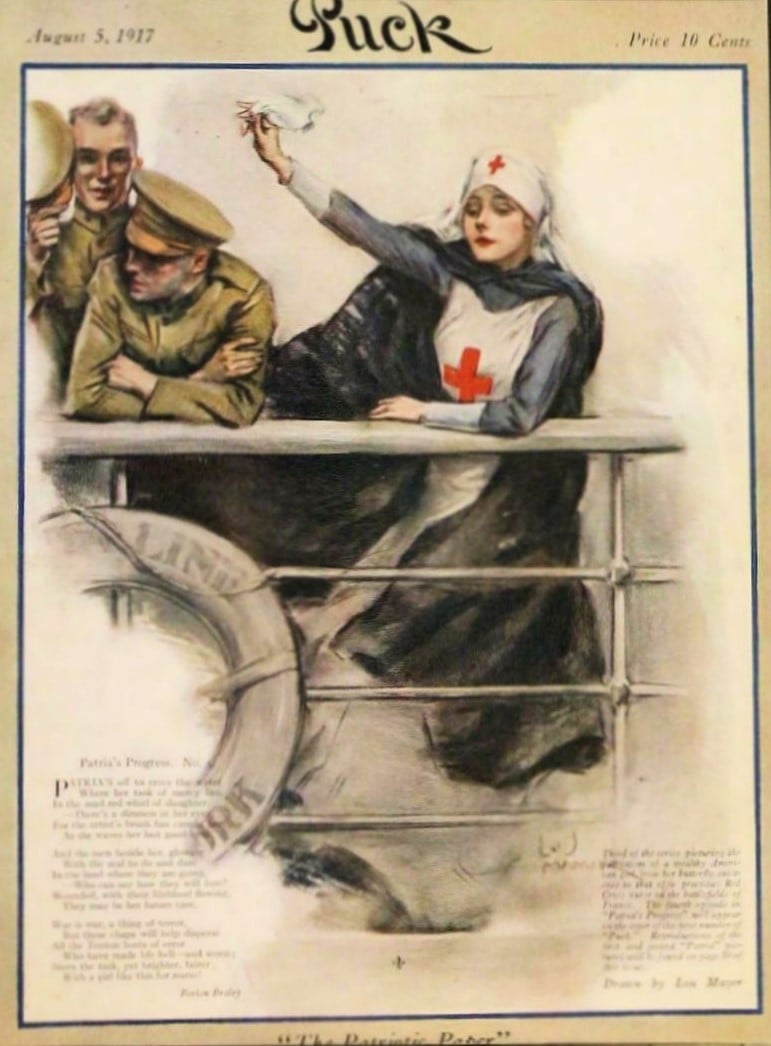
Louis Meyer (1869 – 1969) - American Artist and Sculptor

 With thanks to Chris Dubbs* for finding this “Puck” magazine of August 1917 - cover artwork by American artist and sculptor Louis Meyer (1869 – 1969) and poem “Patria’s Progress No. 3” by American Berton Braley (1882 – 1966)


Born in Milwaukee, Louis Mayer studied at the Wisconsin Art Institute, before traveling to Europe where he attended the Weimar Art School and the Munich Academy of Fine Arts, as well as the Académie Julian in Paris. He returned to his home state, taught at the Wisconsin School of Art, and help found the Society of Milwaukee Artists. He later moved to Fishkill, New York, where he took up sculpting. Eventually he settled in Carmel, California.

“Puck” was the first successful humour magazine published in the United States containing colourful cartoons, caricatures and political satire of the issues of the day. It was founded in 1871 as a German-language publication by Joseph Keppler, an Austrian-born cartoonist. The first English language edition of “Puck” was published in 1877, covering issues like New York City's Tammany Hall, presidential politics, and social issues of the late 19th century to the early 20th century. The magazine ceased publication in 1918.

"Puckish" means "childishly mischievous". This led Shakespeare's Puck (from his play “A Midsummer Night's Dream”) to be recast as a charming boy and used as the title of the magazine. “Puck” was the first magazine to carry illustrated advertising and the first to successfully adopt full-color lithography printing for a weekly publication.


* Chris Dubbs is the author of several WW1 books:
"An Unladylike Profession: American Women
War Correspondents in World War 1"
(Potomac Books, Nebraska, 2020)

and

"American Women Reporters in World War One"


Saturday, February 5, 2022

Ion Bărbulescu - B’Arg - (16 December 1887 - 1 November 1969) - Romanian artist

With thanks to Ognyan Hristov for finding quite so many amazing artists, among them B'Arg

Ion  Bărbulescu signed his work B'Arg. He was a Romanian painter, illustrator and journalist, who was mainly active between the two World Wars. 

Born in Odobesti, Ion inherinted his interest in the arts from his grandfather, a church painter. He had regular features in Toamna, Revista Copiilor si a Tinerimii (Children and Youth Magazine) and Dimineata Copiilor (Morning Children) as early as 1906, while his first solo exhibition was in Bucharest in 1915.

B'Arg commented on social and cultural events in both his drawings and articles, that were printed in magazines like Adevărul (1907-1948), Adevărul Literar şi Artistic” (1921-1948) and Cuvântul Liber (1933-1936). 

His many writings and studies of the arts and cultural scene provide an interesting account of the social, political, moral and human standards of the Romanian society during the 1910-1940 period.


B'ARg's Painting Soldier reading a letter in a shelter during the The Battle of Mărășești, WW1.  

The Battle took place between  6 August 1917 and 3 September 1917 and was the last major battle between the German Empire and the Kingdom of Romania on the Romanian Front during World War I. Romania was mostly occupied by the Central Powers, but the Battle of Mărășești kept the northern region of the country free from occupation.

Posted by Ognyan Hristov on the Facebook Page Artists of the First World War on 31 January 2022  https://www.facebook.com/groups/385353788875799


Brake Baldwin (1885 - 1915) – British artist

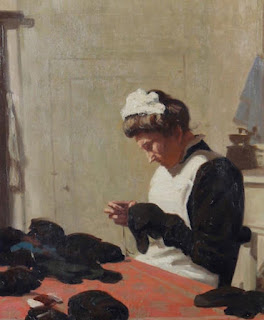
With thanks to Historian Debbie Cameron for finding this artist and his beautiful painting of the family’s cook darning socks during a Zeppelin Raid in WW1

Born John Brakewell Baldwin in Eltham, Kent in 1885, Brake's parents were John Baldwin, a Civil Engineer, and his wife, Sarah A. Baldwin, nee Clarke.  Educated at Forest School, Walthamstow, Brake went on to study art.  

On 6th April 1911, Brake married Edith Mary Wilson in Leamington Spa, Warwickshire.  Edith was the daughter of Edith Berridge (who was also an artist), and the stepdaughter of Thomas Berridge, an engineer. 

Between 1912 and 1914, Brake Baldwin's work was exhibited widely, frequently with famous artists such as Lavery, Orpen and Sargent at the Royal Institute of Oil Painters, or alongside Glyn Philpot, Augustus John and Walter Sickert at the National Portrait Society. Brake’s work regularly received favourable write-ups in London newspapers. 

During the First World War, Brake lived in London and was the Quartermaster of the 31st London Division, Voluntary Aid Detachment (V.A.D.). He devoted himself unsparingly to Red Cross work and died after an operation for internal problems on 30 July 1915 at a London nursing home. The men of his Division paid a last tribute by forming an escort and bearing the coffin to the train at Paddington for the journey to Leamington Spa where the funeral was held.


Sources:  Find my Past, Free BMD and

https://www.courtgallery.com/artists/653-brake-baldwin/works/10747/

https://www.britishnewspaperarchive.co.uk/viewer/bl/0000635/19150716/172/0006

https://www.britishnewspaperarchive.co.uk/viewer/bl/0001670/19150807/102/0004


Sunday, January 9, 2022

Frank Algernon Stewart (1877-1945) - British artist


With thanks to Ognyan Hristov for discovering this amazing artist who was also a war correspondent during the Boer War.


Frank was born in Croydon, UK on 16th October 1977.  His parents were Ebernezer Stewart, a seed crusher, and his wife, Mary Ann Stewarat, nee Betts.    Educated in Hastings, Frank studied art under George Ward in Rochester, Fred Brown at the Slade, and Frank Calderon at the School of Animal Painting. Frank became a war artist for “The Illustrated London News” and in October 1899 went to Africa where he saw action at Colenso, Spin Kop, Monti Christo and the releif of Ladysmith during the Second Boer War.

Invalided home, Frank went to Paris in 1901, to study at the Académie Julian with Rodolphe Julian.  In 1903, he married Eliza Jane Brown in Havant, Hampshire.  The couple lived in Croydon but Eliza Jane died in December 1905.   

Sketch by Frank of General Buller riding in to greet General White outside the Town Hall in Ladysmith - 28 February 1900   Sketched in situ by Frank Algernon Stewart, the official Boer War artist of the London Illustrated News who came to South Africa in October 1899.


The Surrey Yeomanry on the Struma Valley Front, Salonika 1917-1918. The Evening Wireless - Komarjan Bridge. By Frank Algernon Stewart .


During the First World War, Frank served in the King Edward's Horse, Norfolk Yeomanry. Frank was a keen huntsman and his work was predominantly of hunting scenes. In later life he was forced to give up hunting as the result of an operation, but he continued to follow the hounds on foot, making sketches of hounds running.

By 1939, Frank had re-married and he and his wife, Muriel Winifred, lived in Cheltenham in Gloucestershire, where he died in June 1945. 

NOTE:  The Académie Julian was a private art school for painting and sculpture founded in Paris, France, in 1867 by French painter and teacher Rodolphe Julian (1839–1907) that was active from 1868 until 1968. The Academy remained famous for the number and quality of artists who attended during the great period of effervescence in the arts in the early twentieth century.  After 1968, the Academy integrated with ESAG Penninghen.

William Frank Calderon and Charles Edward Johnson, a landscape artist, started the School of Animal Painting at 54 Baker Street, London in April 1895 and Frank Calderon was the school’s Principal until 1916.


Thursday, January 6, 2022

Percy Hague Jowett (1882–1955) was a British artist who became Principal of the Royal College of Art

Found by Ognyan Hristov


 Portrait by Peter Coker 

Percy was born in Halifax, Yorkshire, UK on 1st June 1882.  His parents were Smith Jowtt, a schoolmaster, and his wife, Lucinda Georgina Jowett, nee Hague, who was a schoolmistress.  Percy has a sister, Gertrude, who was born in 1885. 

He studied art at Leeds College of Art and London's Royal College of Art.

In September 1912, Percy married Enid Ledward, sister of the sculptor, Gilbert Ledward.

During the First World War, Percy served in the Royal Garrison Artillery, first as a Corporal then as a Second Lieutenant.

In 1927, Percy became head of Chelsea School of Art, and in 1935, principal of the Royal College of Art, succeeding William Rothenstein, and went on to give the sculptor Henry Moore his first job.  

During the Second World War, Percy served as a committee member with the War Artists' Advisory Committee. He retired from the RCA in 1948.

“England, Triptych” by Percy Jowett, First World War. circa 1918

Sources: Find my Past, Free BMD 

https://www.facebook.com/groups/385353788875799

Portrait of Howett - Percy Hague Jowett (1882–1955) by Peter Coker (1926–2004)

A triptych is an artwork made up of three pieces or panels. 


Alfred Basel (1876-1920) - Austrian artist and etcher

Alfred Basel was born on 23 March 18 in Vienna. His father was a factory owner. Alfred studied at the Wiener Kunstgewerbeschule under Felician von Myrbach between 1892 and 1898. 

He was a reserve officer during the First World War, serving with the rank of Oberleutnant in the Fourth Army on the Galician Front from March 1915. In the autumn of that year, Alfred became ill and was declared unfit for military service. By November 1915, he had been appointed to serve as a war artist serving the Kriegspressequartier. In 1916 he was on the Vistula, in the Carpathians, in Albania, on the Isonzo, and in the Ukraine. It was his artistic breakthrough.


In 1919, at the winter exhibition of the Wiener Künstlerhaus, Basel exhibited his work outside of the Kriegspressequartier for the first time. His treatment of military events was careful and accurate, and both stylistically and biographically he has many similarities to Oskar Laske. Like him, Basel avoids sensationalising or exaggerating, and favours crowds of small figures and a simplicity approaching photographic accuracy.

Alfred died on 24 January 1920 from the effects of a hunting accident in Dickenau, Türnitz, Lower Austria.