Friday, August 19, 2022

Alfred Crowdy LOVETT (1863 – 1919) – British soldier and very prolific artist

Alfred Crowdy Lovett was born in Croydon, Surrey, UK in the early months of 1863.  His parents were James Crowdy Lovett and his wife, Ellen Hawkins Lovett, nee Bevan.   Alfred was baptised in St James church, Croydon on September 5th 1863. He first appeared on the census of 1871 aged 8 and living at Addiscombe Road, Holly Mount, Croydon with his parents and brothers.

In 1882 Alfred became a Lieutenant in the 4th Bn. The East Surrey Regiment. 

By the 1901 census, he was aged 38, single and a Captain in the Infantry. The census was for the parish of Sandhurst, Berkshire.

In the second quarter of 1903, Alfred married Fannie Rumsey in Maryleborne London.  He served during WW1, commanding the 1st Gloucestershire Regiment at the retreat from Mons in 1914.  

Alfred’s military career was distinguished and he was gazetted twice. On 16/02/1915 (gazette date) he was made a Companion of the order of the Bath, and on 3/02/1919 in the King’s Birthday Honours he was awarded a CBE. He was by then a Brigadier General and on the “general staff”.

Alfred Crowdy Lovett  “died of illness in the U. K. and was buried in Manor Road Cemetery grave ref. the oval.17. At his death he is listed as having served in the General Staff & the Gloucestershire Regiment, which he joined in 1883. 

Medals:

Silver Star, Victory and British War Medals

C.B. C.B.E. Mentioned in Dispatches

As well as being a distinguished soldier, Alfred Crowdy Lovell was a talented artist, his work being shown at the Royal Academy.   He also wrote books:


“India and the War” (Hodder and Stoughton, London, 1915) and

“The Armies of India painted by A.C. Lovett ; described by G.F. MacMunn” ;-with foreword by Earl Roberts (Adam and Charles Black, London, 1911)


Alfred is remembered in Manor Road Cemetery and on the WW1 Roll of Honour at Whitgift School where he was a pupil. 

Roll of Honour at Whitgift School

Sources:

https://www.scarboroughcemeteries.co.uk/database/lovett-alfred-crowdy/

https://onlinebooks.library.upenn.edu/webbin/book/lookupname?key=Lovett%2C%20Alfred%20Crowdy%2C%201862%2D1919

https://glosters.tripod.com/1919off.html

https://www.google.com/search?q=alfred+crowdy+lovett&rlz=1C1CHBD_en-GBGB794GB794&source=lnms&tbm=isch&sa=X&ved=2ahUKEwidlND7ldH5AhWQa8AKHSAFD6UQ_AUoAXoECAEQAw&biw=1280&bih=824&dpr=1


Thursday, August 11, 2022

George Mayer-Marton (1897 – 1960) - Hungarian artist

self portrait
While researching yesterday, I found a Hungarian artist who served in WW1 - George Mayer-Marton (3 June 1897 – 8 August 1960) - a Hungarian artist who was a significant figure in Viennese art between the First and Second World Wars, working in oil, watercolour and graphics. 

Mayer-Marton was born György, or Georg in German, in Győr, Kingdom of Hungary in 1897, and grew up during the final years of Austro-Hungary. He served in the Austro-Hungarian Army during the First World War. From 1919 to 1924 he studied art at the Academy of Fine Arts Vienna and Academy of Fine Arts, Munich, and also visited Ravenna in Italy

Following his emigration to England in 1938, he changed the spelling of his forename to George on British naturalization. He continued to paint in watercolour and oil. He pioneered the technique of Byzantine mosaic in the UK. In 1952, he took up the post of Senior Lecturer in the department of painting at the Liverpool College of Art and introduced the new subject of mural art.  I could not find any WW1 paintings by him but I feel he should be remembered.


Alfred Edmeades "Fred" Bestall, MBE (1892 – 1986) - British artist

With thanks to Historian Debbie Cameron for this information  


Alfred Edmeades Bestall wrote and illustrated the “Rupert Bear” cartoon stories for the London “Daily Express” newspaper from 1935 to 1965.   The original creator of the Rupert Bear stories was British artist Mary Tourtel (born Mary Caldwell on 28 January 1874 – 15 March 1948). In 1900 she married an assistant editor of “The Daily Express”, Herbert Bird Tourtel. 

The initial purpose of the Rupert Bear stories which began on 8th November 1920, was to win sales from rival  newspapers “Daily Mail” and “Daily Mirror”.

Alfred won a scholarship to the Birmingham Central School (later College) of Art and later attended the London County Council (LCC) Central School of Arts and Crafts in Camden. He served in the First World War as an MT (motor transport) driver in the British Army in Flanders, transporting troops, ammunition and stores in a range of vehicles including converted double-decker London B-Type buses, often under enemy fire. Following the war, Bestall finished his studies at the Central School of Art and was hired to illustrate books by Enid Blyton

Additional information from

https://www.beddgelerttourism.com/Rupert/


Friday, July 8, 2022

Artists/Photographers, etc. who were awarded special medals for outstanding bravery during the First World War

These are the names I have found so far.  If you know of any others please get in touch with me. Thank you. 


Joseph Marius Jean Avy (1871 - 1939) - French Croix de Guerre – French artist 

Geoffrey de Gruchy Barkas, MC, artist/film maker

Hans Bartle (1880 - 1943) - Austrian official WW1 artist. Iron Cross; Silver Medal for Bravery; the Knight's Cross of the Franz Joseph Order

Alan Edmund Beeton, MC

John Warwick Brooke DCM – official WW1 war photographer

John Cosmo Clark, MC (1897 – 1967) – British artist and art teacher; served in Artists Rifles WW1

Philip Lindsey Clark, DSO, ARBS (1889–1977)  - British sculptor. In December 1917, he was awarded the Distinguished Service Order (D.S.O) for "...conspicuous gallantry and devotion to duty when in command of the left flank company of the battalion."

Helena Gleichen OBE, DStJ  (1873 – 1947) – artist. For her First World War work, Helena was awarded the Italian Bronze Medal of Military Valour and was invested as a Dame of Grace of the Order of St John of Jerusalem and as an OBE in 1920.

William Robert Gregory MC (1881 – 1918)  - Irish-born, RFC/RAF British airman, artist and cricketer; France made him a Chevalier of the Legion d'Honneur in 1917

Antony Gibbons Grinling, MC – artist and sculptor

Carl W Herman, MM (1888 – 1955) – artist

Christopher Wyndham Hughes MC (1881-1961) - artist; served as Temporary Captain in the 7th Battalion Wiltshire Regiment 

Charles Sargeant Jagger MC ARA (1885 – 1934) British sculptor

Richard Barrett Talbot Kelly MC (1896-1971), Lieutenant Royal Field Artillery

Paul Maximilien Landowski, Croix de Guerre (1 June 1875 – 31 March 1961) – French Scultpor and WW1 camouflage artist 

A W Lloyd, MC – Arthur Wynell Lloyd (1883 - 1933) – British cartoonist

Walter Marsden MC (1882–1969) – sculptor

John B. McDowell, MC, BEM (1877 – 1954) – British film maker, director and cameraman during WW1

Waldo Peirce (December 17, 1884 – March 8, 1970) - an American painter, who for many years revelled in living the life of a bohemian expatriate.  Awarded the Croix de Guerre

William Charles Penn MC (1877 – 1968) - artist; 5th Battalion The King’s (Liverpool) Regiment

Geneste Penrose MM (1889 – 1974) – artist 

Gerald Spencer Pryse MC (1882–1956) - British artist and lithographer.

E. Claude Rowberry, MM, (1896 - 1962) – artist

E.H. Shepard, MC (1879 – 1976) – artist (illustrator of A.A. Milne’s “Pooh” stories

William George Storm, MC (1882 - 1917) – Canadian artist

Dents Wells, BEM (1881-1973) served in the Artists Rifles during WWI; awarded a B.E.M. for gallantry. https://en.wikipedia.org/wiki/British_Empire_Medal

Charles Arthur Wheeler, DCM (1880 - 1877) - New Zealand artist. Served in 22 Bn Royal Fusiliers; awarded the Distinguished Conduct Medal (1916) for his actions at Vimy Ridge

Sir George Hubert Wilkins MC & Bar (31 October 1888 – 30 November 1958).


Monday, May 30, 2022

Cyrus Cincinato Cuneo (1879 – 1916) – American-born official British WW1 artist

Few people these days have heard of official First World War Artist, Cyrus Cincinato Cuneo.    

Self Portrait
Cyrus Cuneo was born in San Francisco in America in 1879.  His parents were John Cuneo and his wife Annie, nee Garaboldi, who were of Italian origin.  Cyrus's brothers Rinaldo and Egisto also became artists but his sisters, Erminia, Clovinda and Evelina, preferred music.

Cyrus demonstrated artistic ability at an early age and worked hard to save enough money to go and study art in Paris.   With his brother Rinaldo, Cyrus, who was very athletic, became a boxer, entering contests and winning prizes.  Cyrus became a Flyweight Boxing Champion in San Francisco.   By 1896, he had enough money to go to Paris where he enrolled at the Academie Colarossi and was a pupil of the American artist James Whistler (1834 – 1903).

Six years later, Cyrus went to live in England.  In 1903, he married Nellie Marion Tenison, who was also an artist.  The couple met in Paris where Nellie had also studied with Whistler.   

In 1911, the couple lived in Uxbridge Road, Hammersmith, London with their two children Desmond and Terence, and Nellie's widowed mother, Frances Tenison.  Cyrus worked as an illustrator for publications such as "The Strand Magazine" and the "Illustrated London News".  He also produced illustrations for some of the best known writers of the era such as Arthur Conan Doyle,  E.W. Hornung (both of whom were members of the J.M. Barrie recreational cricket team) and H. Rider Haggard, to name but a few.  Cyrus was a member of the Royal Institute of Oil Painters and his work was exhibited at The Royal Academy.

When King Edward VII died on 6th May 1910, Cyrus went without sleep for four nights and worked solidly to produce four double page spreads of the funeral for the "Illustrated London News".   

When the First World War broke out, Cyrus became an official War Artist.   One of his paintings was auctioned in 1915 and raised sufficient funds to purchase two ambulances which were sent to France bearing the inscription "The Cyrus Cuneo Ambulance". 


“A Thrilling Charge”, illustration by Cyrus Cuneo from “Told in the Huts: The YMCA Gift Book”, published 1916


“Retreat from Serbia” by Cyrus Cuneo 
Cyrus died on 23rd July 1916 after a brief illness at the age of 37 after having been accidentally stabbed with a hatpin at a dance. 

Cyrus’s son, Terence Cuneo, also became an artist and was an official artist of the Queen’s Coronation in 1953. His famous trade-mark – a mouse – featured in all of his paintings.


For more illustratons by Cyrus Cuneo, please see http://artcontrarian.blogspot.com/2016/10/cyrus-senior-cuneo.html

Sources:  Carole Cuneo, President of the Cuneo Society https://thecuneosociety.org/
Find my Past and Free BMD 

Friday, May 27, 2022

Ernest Maitland T. Coffin (1868-1944) – British artist

With thanks to Historian Debbie Cameron for finding this artist

Ernest Maitland T. Coffin was born on 13th December 1868 in Stoke Damerel, Devonshire, UK.    Stoke, also referred to by its earlier name of Stoke Damerel, is a parish, that was once part of the historical Devonport, UK.  In 1914, Devonport and Plymouth amalgamated with Stonehouse and the new town took the name of Plymouth. Since the amalgamation, Stoke has been an inner suburb of Plymouth in the English County of Devonshire. 

Ernest’s parents were Thomas Coffin, a surgeon and General Medical Practitioner, and his wife, Mary Augusta Coffin, known as Maria, nee Tause, who were married in March 1868.  Ernest had the following siblings: Ethel, b. 1870, Claud D'Eresby, b. 1875 and Algernon Crawford, b. 1875.

The family moved from Devonshire to live in London and by 1891, they were living in Hampstead and Ernest was studying medicine.  

In 1910, Ernest married Almeida Roberts and on the 1911 Census,  the couple were living in Westminster, London and Ernest’s occupation was listed as artist.  

Ernest produced a series of lithographs for the British Empire Exhibition held at Wembley, London April to October 1924. 

By 1939, Ernest and Almeida were living in Croydon, Surrey and Ernest’s occupation was listed as ‘artist – retired’.  Ernest died in December 1944.

The illustration by Coffin is from a magazine advertisement for insurance in “The Telegraph and Telephone Journal”, October 1917

Sources: Find my Past, Free BMD and “The Telegraph and Telephone Journal”, October 1917

http://www.samhallas.co.uk/repository/journals/Telegraph_%26_Telephone_Journal/Whole%20year%20editions/Telegraph%20and%20Telephone%20Journal%20-%20Vol%2004%20%28Oct%201917%20-%20Sep1918%29.pdf?fbclid=IwAR0BTihPFBgaAXAbCpNvwQvHEYfd1hN3v_vbxZVjLifXDn5D-lzp0QvHakU


Saturday, April 30, 2022

Louis Meyer (1869 – 1969) - American Artist and Sculptor

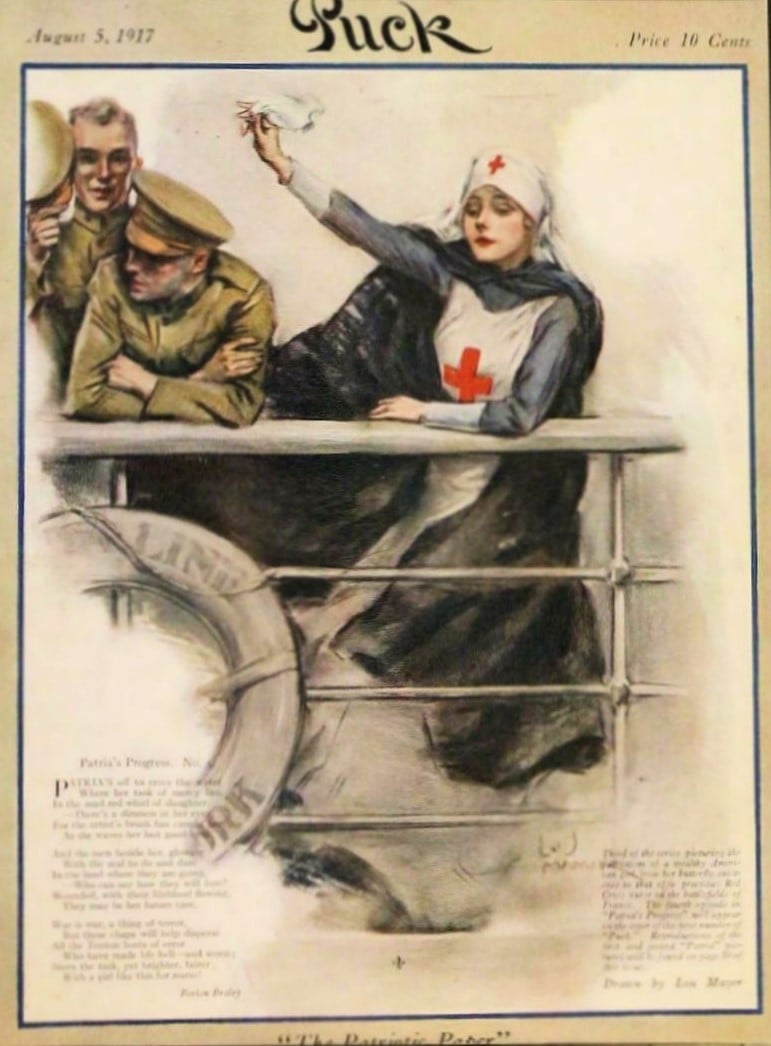
 With thanks to Chris Dubbs* for finding this “Puck” magazine of August 1917 - cover artwork by American artist and sculptor Louis Meyer (1869 – 1969) and poem “Patria’s Progress No. 3” by American Berton Braley (1882 – 1966)


Born in Milwaukee, Louis Mayer studied at the Wisconsin Art Institute, before traveling to Europe where he attended the Weimar Art School and the Munich Academy of Fine Arts, as well as the Académie Julian in Paris. He returned to his home state, taught at the Wisconsin School of Art, and help found the Society of Milwaukee Artists. He later moved to Fishkill, New York, where he took up sculpting. Eventually he settled in Carmel, California.

“Puck” was the first successful humour magazine published in the United States containing colourful cartoons, caricatures and political satire of the issues of the day. It was founded in 1871 as a German-language publication by Joseph Keppler, an Austrian-born cartoonist. The first English language edition of “Puck” was published in 1877, covering issues like New York City's Tammany Hall, presidential politics, and social issues of the late 19th century to the early 20th century. The magazine ceased publication in 1918.

"Puckish" means "childishly mischievous". This led Shakespeare's Puck (from his play “A Midsummer Night's Dream”) to be recast as a charming boy and used as the title of the magazine. “Puck” was the first magazine to carry illustrated advertising and the first to successfully adopt full-color lithography printing for a weekly publication.


* Chris Dubbs is the author of several WW1 books:
"An Unladylike Profession: American Women
War Correspondents in World War 1"
(Potomac Books, Nebraska, 2020)

and

"American Women Reporters in World War One"