Thursday, July 17, 2025

Gilbert Spencer RA (1892 - 1979) - British artist who served in Salonika during WW1

Gilbert Spencer (4th August 1892 – 14th January 1979) was a British artist who painted landscapes, portraits, figure compositions and mural decorations working in oils and watercolour. 

He was the younger brother of the artist Stanley Spencer. During the First World War, after somewhat pacifist misgivings on the part of both themselves and their mother, both Stanley and Gilbert served in the Royal Army Medical Corps, initially at the Beaufort War Hospital in Bristol. Gilbert was then drafted to the Macedonian front, serving in Salonika and in the Eastern Mediterranean 1915–19. He returned to his studies at The Slade after the war (1919–20).

(Sir Stanley Spencer, CBE RA (30 June 1891 – 14 December 1959) also served in Salonika during WW1. 

To mark of the launch of the remarkable new Gilbert Spencer Online Catalogue (details below) - Liss Llewellyn is delighted to announce a selling exhibition of some of his finest works.

The Gilbert Spencer Online Catalogue has been directed by Professor Paul Gough, with content by Dr Amy Lim and website design and build by Rich Tarr. It has been generously funded by a grant from the Research and Knowledge Exchange Committee at Arts University Bournemouth.

For further information, please contact Eva@lissllewellyn.com

https://gilbertspencercatalogue.org/


Saturday, June 14, 2025

John MacGilchrist (1893 – 1977) – Scottish born American artist

With thanks to Gregory VanWyngarden who discovered this artist and posted the information and image on the Facebook Group Artists of the First World War.

John MacGilchrist was born on 12th July 1893 in Stirling, Scotland  He studied architectural drawing and painted initially mainly Scottish castles. 

In 1913, John travelled to the United States of America to complete his degree in architecture at Carnegie Tech in Pittsburgh. 

John MacGilchrist became a prominent American aviation artist and he enlisted and served during World War I as a Balloon Observer for the British Royal Flying Corps. 

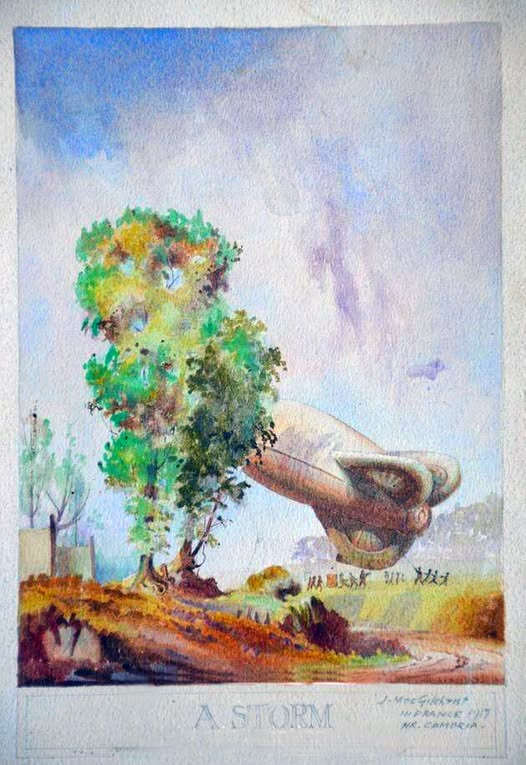
Despite having been shot down four times, John survived over 200 hours of balloon observation and chronicled images of the war. He painted watercolor scenes of balloons and aircraft during his service at the front. 

After the war, John returned to the USA to pursue his profession as an architect in Philadelphia and New York. In 1926, however, he left architecture and returned to his romance with planes. His techniques ranged from etchings and lithographs to watercolors and oil paintings. In the 1932 Olympics, John MacGilchrist entered three etchings in the graphics section of the Olympic Art Competitions. 

After falling into obscurity during the Great Depression John's career ended and his work was only re-discovered after his death. 

John MacGilchrist died in May 1977 in Coronado, California, USA.

Here is his 1917 painting of a balloon crew hauling their gasbag down in "A STORM."


Sources:  Wikipedia,

https://www.facebook.com/groups/385353788875799 14th June 2025

Sunday, June 1, 2025

Horace Moore-Jones (1868 – 1922) – British born New Zealand artist

With thanks to Paul Simadas for finding Horace.for us and researching the following information:

Horace was born in 1868 in England and later emigrated to Australia and then on to New Zealand. Pre-war he was a notable artist.  When he was 46, Horace enlisted in the New Zealand Expeditionary Forces and served at Gallipoli. He fought as a sapper in the Engineers, where his duties included drawing topographical sketches of the terrain for military use.

When he was wounded, Horace was evacuated to England to recover. There he completed a number of water colour and ink paintings depicting Gallipoli scenes. They were exhibited in London in 1916 to acclaim. 

Horace toured New Zealand with his paintings in 1916-17, in part raising funds for NZ returned servicemen. After the war, he became an art teacher. Horace tragically died in a hotel fire in Hamilton NZ in 1922, a sad loss for his country.

Many of his paintings, some seventy, had previously been sold to the Australian Government. 


‘The unpretentious tent of General Sir Ian Hamilton, Imbros’, watercolour over pencil on paper, Horace Moore-Jones, 1915.

NOTE Sir Ian Hamilton commanded the Mediterranean Expeditionary Force that fought the campaign on the Gallipoli Peninsula. This was his second headquarters’ location and would not be his last. 

The first HQ was aboard the super-Dreadnought battleship HMS Queen Elizabeth. German submarine activity in the Aegean Sea forced the ship’s withdrawal. Its loss would have constituted a serious loss and damage to British prestige in the East.

The scene for this painting is the shore of Lake Kephelos and the coast of the island of Imbros. The immediate area housed the HQ MEF and a number of military units, including the Australian Bakery, and the general insisted on living with his troops and sharing their deprivations. The Royal Naval Air Service maintained an airfield and seaplane anchorage nearby. Two aircraft are visible in the sky. Sir Ian may be the single figure seen standing outside the tent near the hut. Sir Ian often appeared in the pose the figure has adopted. An olive tree stands isolation.    Unfortunately this arrangement attracted enemy attention and attack. The headquarters moved to a more protected location on the hills overlooking the lake.

Imbros was retained as a British outpost after the final withdrawal from Gallipoli in 1916 and it was a British base into 1919 and later.

Credit: The AWM and Gallipoli Association archival research by Paul Simadas.

Sources:Wikipedia and https://www.facebook.com/groups/385353788875799/?hoisted_section_header_type=recently_seen&multi_permalinks=1902327100511786

Thursday, May 29, 2025

Giulio Aristide Sartorio (1860 – 1932) - Italian painter and film director

Found by Ognyan Hristov and posted on the Facebook page

https://www.facebook.com/groups/385353788875799

Born on 11th February 1860 in Rome, Italy, Sartorio attended the Rome Institute of Fine Arts and presented a Symbolist work at the 1883 International Exposition of Rome. He formed friendships with Nino Costa and Gabriele D’Annunzio, and associated with the painters and photographers of the Roman countryside. He won a gold medal at the Paris Universal Exhibition of 1889 and met the Pre-Raphaelites in England in 1893. His participation in the Venice Biennale began in 1895 with the 1st International Exposition of Art of Venice, after which he taught at the Weimar Academy of Fine Arts from 1896 to 1898.

Sartorio’s period of greatest renown came at the beginning of the century, when he produced decorative friezes for the 5th Esposizione Internazionale d’Arte of Venice (1903), the Mostra Nazionale of Fine Arts (Milan, Parco Sempione, 1906) and Palazzo Montecitorio in Rome (1908–12). 

Sartorio served during the First World War and was wounded. After the war he travelled extensively in the Middle East, Japan and Latin America during the 1920s and became a member of the Italian Royal Academy.

Sartorio dued on 3rd October 1932. 

Sources: Wikipedia and Ognyan Hristov


Wednesday, May 21, 2025

Michael Zeno Diemer (1867-1939) - German artist

Michael Zeno Diemer was a German artist. Now known primarily for his marine paintings and postcard designs, he was initially famous for his panoramic paintings of battles.

Michael was born on 8th February 1867 in Munich which was then part of the Kingdom of Bavaria.

In 1884, he enrolled at the Academy of Fine Arts, Munich, where he studied with Gabriel Hackl and Alexander von Liezen-Mayer.

Diemer’s fame initially derived from his impressive battle paintings. In 1894, over the course of six months, he worked in Innsbruck, where he created a 1000 square meter (10,800 square feet) panoramic painting depicting the Battles of Bergisel (1809), in which forces led by Andreas Hofer defeated the armies of Napoleon and the Kingdom of Bavaria. It is currently on display at the Innsbrucker Riesenrundgemälde [de]; one of only thirty surviving panoramas from that period.

Another panorama from 1896 depicted the Battle of Bazeilles from the Franco-Prussian War. It was displayed at a specially constructed building in Mannheim and is now lost. He created several works for the Deutsches Museum in Munich; including a Roman aqueduct for the hydraulic engineering display, a Medieval herb garden and the flight of a zeppelin (1909). In Stuttgart, for the "Ketterer", a restaurant at a brewery, he produced a series of fourteen large paintings on the history of Swabian emigration.

As a watercolour artist, he produced numerous landscape paintings and maritime scenes, poster designs, and postcard motifs. He also worked as a musician and a composer.

Michael married Hermine, the eldest daughter of the actress and writer, Wilhelmine von Hillern. Their son, Franz-Zeno Diemer, became a pioneering test pilot and flight engineer.

Michael Zeno Diemer died on 28th February 1939 in Oberammergau.


"Luftkampf" by Michael Zeno Diemer, circa 1917. German Albatros C.III aircaft in combat with British Martinsydes.


Sources:  Wikipedia, 

Ognyan Hristov  - Artists of the First World War  Facebook page 19.9.2021

And Gregory VanWyngarden found a set of paintings by Diemer and posted them on Artists of the First World War Facebook page on 21st May 2025:

https://www.facebook.com/groups/385353788875799/?hoisted_section_header_type=recently_seen&multi_permalinks=1894059661338530


Saturday, May 17, 2025

W.G. Thomas, MC (1883 - 1960) - British WW1 soldier poet who was also an artist

According to his Granddaughter, "W.G. Thomas was never known as William, always Geoff within the family, and it's Geoffry, not Geoffrey.  To his contemporaries he was often referred to simply as W.G. 

Geoff took up painting after the First World War ended – possibly as a healing therapy from war experiences. It is interesting to note that the WW1 soldier poets C.S. Lewis, A.A. Milne  and J.R.R. Tolkien all wrote stories for children following their wartime service in the Army.

Geoff supported other young artists at that time including the potter Basil Matthews. Most of his paintings are of North/mid Wales - as he returned there in his vacations - and some are of the industrial midlands, where he lived."

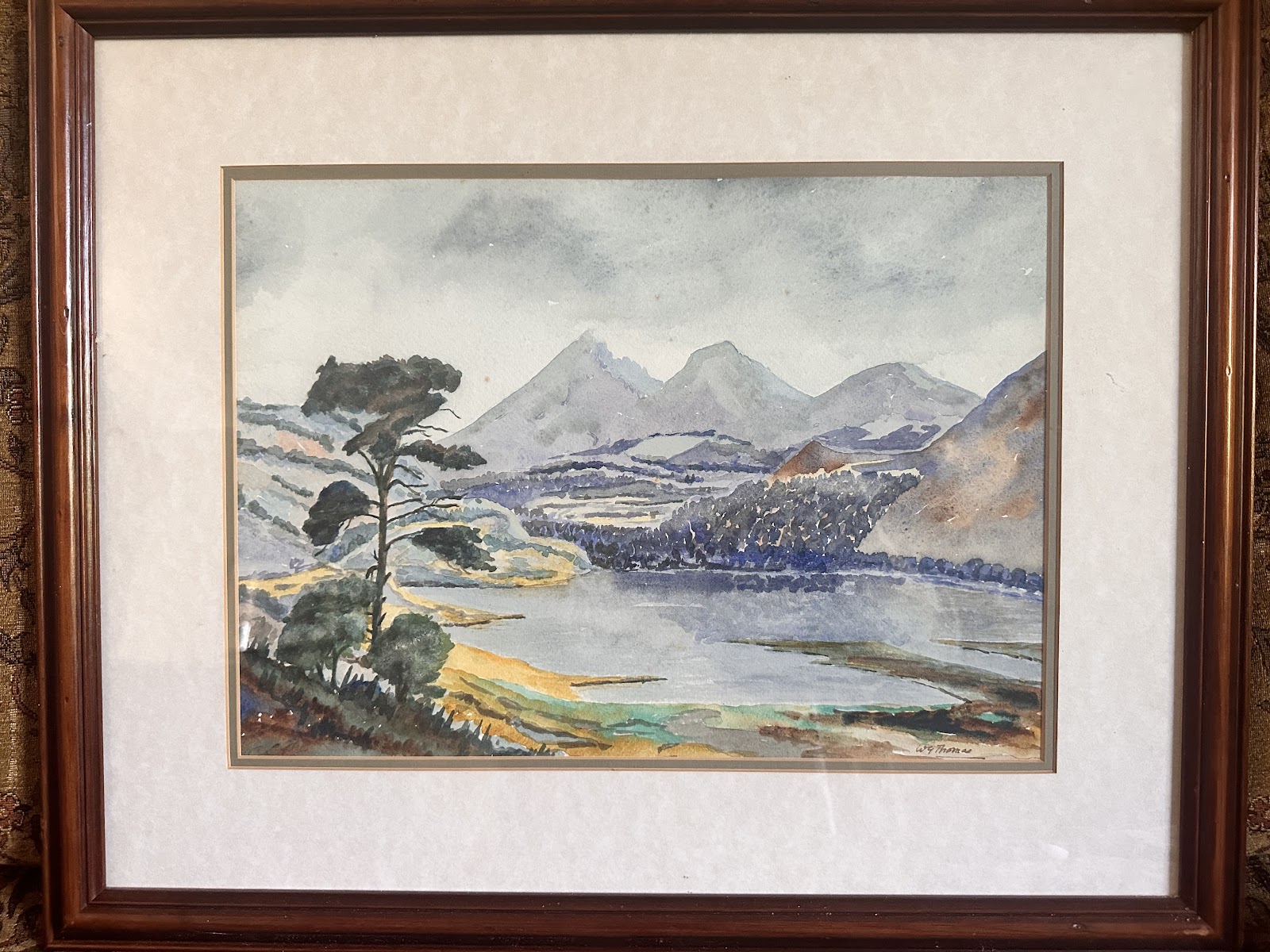
W.G.'s Granddaughter has sent me some photos of some of the works the family have which were done by him.


I have written a post about W.G. Thomas for my Weblog, Forgotten Poets of World War One:

https://forgottenpoetsofww1.blogspot.com/search?q=W+G+Thomas


Sunday, November 17, 2024

Frank Xavier Leyendecker (1876 – 1924) – German-born American artist - also known as Frank James Leyendecker,


With thanks to a very dear friend in America who sent me information regarding Frank. 

Franz Xavier Leyendecker was born in Montabaur, Germany on 19th January 1876. In 1884 he emigrated with his parents and three siblings to Chicago, U.S.A., where an uncle owned the McAvoy Brewery. 

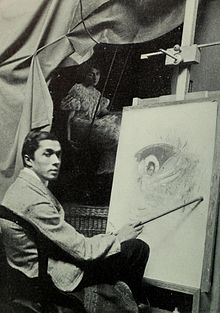
Frank in his studio

Frank studied at the Art Institute in Chicago and between 1895 and 1897 he studied at the AcadĂ©mie Julian in Paris, France.  His elder brother, Joseph Christian Leyendecker (1874 – 1951)  also became an artist and was premier cover illustrator for the magazine “Saturday Evening Post” for much of the first half of the 20th century

Frank became known for his stained glass work as well as his illustrations for posters, books, magazines and advertisements. He provided artwork for advertisements for Kum-a-Part jewelry, E. Howard Watch Company, Franklin automobiles, Kuppenheimer clothes, Right Posture clothes, Ohio Electric Car Company, Remington Arms/Union Metallic Cartridge, Durham hosiery, and BVD underwear. 

He painted covers for a large number of mass-readership magazines including Street & Smith pulp magazines, such as People's Favorite Magazine and The Popular Magazine, as well as for Fawcett's pulp magazine Battle Stories. 

Frank’s artwork for Battle Stories was initially produced as a WWI recruitment poster and reprinted as a pulp magazine cover by Fawcett Publications in 1931. His work was described as an "important feature" of the second exhibition of the Society of Illustrators at the International gallery in New York.

Frank died on 18th April 1924. 


"The Letter Home" by Frank Xavier Leyendecker