Friday, October 29, 2021

Keith Henderson (1883–1982) – Scottish artist

With thanks to Ognyan Hristov for finding this artist for us

"A Wrecked Railway Bridge
Near The Hindenburg Line
Near Villers Guislain", 1917 
Born in Scotland and brought up in Aberdeenshire and in London, Keith was one of three children born to George MacDonald Henderson, a barrister at Lincoln's Inn, and his wife, Constance Helen, née Keith. He attended Orme Square School in London and Marlborough College, before going on to study art at the Slade School of Art, London and the Académie de la Grande Chaumière in Paris.

During the First World War, Keith served as a Captain with the Royal Wiltshire Yeomanry on the Western Front. He painted several works while there and also wrote a book about his experiences entitled “Letters to Helen: Impressions of an Artist on the Western Front” which was published in 1917. 'Helen' was his wife - Helen Knox-Shaw – they were married in 1917 at St Martin-in-the-Fields in London.


"A Twelve-inch Gun", 1917

During the Second World War, Keith Henderson was one of the first two artists, along with Paul Nash, appointed as a full-time salaried artists to the Air Ministry by the War Artists' Advisory Committee, WAAC. Henderson was sent to RAF bases in Scotland.


Sunday, October 3, 2021

Rudolf Helmut Sauter (1895 – 1977) – British/German artist, illustrator, poet

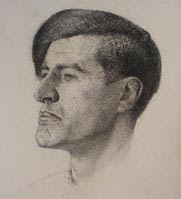
Portrait of Rudolf by
his Father Johann Georg Sauter
Rudolf was born on 9th May 1895. His parents were Blanche Lilian, nee Galsworthy and Johann Georg Saunter, an artist from Bavaria in Germany. Educated at Harrow School, Rudolf studied art in London and Munich.  He was also a writer and later joined the PEN Club – founded by British writer Catherine Amy Dawson Scott in 1921. Rudolf’s Mother, Blanche Lilian, was the elder sister of the writer and poet John Galsworthy.  Rudolf illustrated an edition of his Uncle’s work.

During WW1, Rudolf was interned in Alexandra Palace Internment camp, north London, and Frith Hill camp at Frimley, Surrey.

Rudolf showed his work in London, the provinces, Paris at the Salon, where he gained an Hon. Mention, and widely in America. Much of Sauter’s work was destroyed in a fire in the early 1980s, yet a lot is in private hands in South Africa.


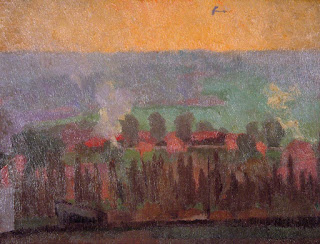
A painting by Rudolf Sauter

An Aeroplane viewed from the
Alexandra Palace Internment Camp
Compound 

Rudolf died on 12th June 1977.


Tuesday, September 28, 2021

Gerald Maurice Burn (1862-1945) - British artist

Gerald Maurice Burn was an artist and engraver. He exhibited at the Royal Academy 1881-1887 and was working on ship portraits in 1915. In the "Evening Post" for 29 January 1913, Page 4, he is described as "an artist residing at Amberley, near Arundel".

Painting of ‘HMAS Australia’, 1913 oil on canvas, signed and dated ‘Gerald M. Burn, 1913'. Artist: Gerald Maurice Burn (British, 1862-1945).


Tuesday, September 21, 2021

A painting of the Zeebrugge Raid in 1918 by Charles John de Lacy (1856 – 1929)


A painting of the Zeebrugge Raid in 1918 by Charles John de Lacy (1856 –  1929), who was one of the foremost British marine artists of his period. He was especially known for his warship imagery and was regularly commissioned by Elswick, Tyne and Wear shipbuilder W. G. Armstrong Whitworth.

The picture shows HMS Vindictive - a British Arrogant-class cruiser built at Chatham Dockyard. She was launched on 9 December 1897 and completed in 1899.  It looks as though the other vessel may be one of the Mersey Ferries that took part in the Raid.

Early in 1918 HMS Vindictive was fitted out for the Zeebrugge Raid. Most of her guns were replaced by Howitzers, flame-throwers and mortars. On 23 April 1918 she was in fierce action at Zeebrugge when she went alongside the Mole, and her upperworks were badly damaged by gunfire.  Her Captain, Alfred Carpenter, was awarded a Victoria Cross for his actions during the raid. The painting hangs in the Britannia Royal Naval College.

With thanks to the Rev. Nicholas Pye @RevdPye on Twitter for finding this painting.


Photo of Charles John de Lacy in 1909
Photo of Charles John de Lacy in 1909.

Charles was the son of Robert de Lacy, a professor of music, and his wife Eliza, nee Smith. Charles was born in 1856 in Sunderland, County Durham, and grew up in the Bishopwearmouth area of the city.  By 1870 his family had relocated from the North East of England to Lambeth in London.   While in Lambeth he married Alice Harriet Hill in 1880 and they had two daughters, Constance Rosamond De Lacy (b. 1881) and Irene Valerie Cristoforo De Lacy (b. 1901). 

He first exhibited at the Royal Academy in 1889, having undertaken training at The National Gallery. Magazines such as “The Illustrated London News” were among early patrons.


Charles died in Epsom, Surrey on 13th December 1929.


Sunday, September 19, 2021

Stepan Feodorovich Kolesnikov (1879-1955) - Ukrainian artist

Stepan Feodorovich Kolesnikov lived and worked in Tsarist Russia and the USSR.


Three paintings by Stepan found for us by Ognyan Hristov and posted on the Facebook Group

Artists of the First World War https://www.facebook.com/groups/385353788875799

′′ On alert (post) ", 1914, pencil and guash on paper.


′′ Messenger in the Caucasian Mountains ", 1915, ink and guash on cardboard.


“Easter on the front ", 1915/16, pencil and guash on paper.


Tuesday, July 20, 2021

British artists sent to the South (Macedonian or Thessaloniki) Front. They painted between 1916 and 1918

With thanks to Ognyan Hristov for finding these artists and their work 

and for his help in finding other artists of WW1


1. ′′ The front near the river Vardar ", 1917, watercolor;

Artist: Joseph Denovan Adam Jnr (1881-1935), son of Joseph Denovan Adam (1841-1896).


2. ′′ Hours on post ", 1917, watercolor; 

Artist: Joseph Denovan Adam Jnr (1881-1935)


3. ′′ Close to the positions near Lake Doiran ", 1917, watercolor;


Artist: Robert Houston (1891), Scottish.  Served in the British army in Macedonia in 1917 Located in Thessaloniki, draws numerous watercolors and drawings from the areas of Thessaloniki, Lake Doiran and Belasitsa Mountain.


4. ′′ Transportation of injured in the village of Small ′′ (Aegean Macedonia), 1916, oil;


Аrtist: Sir Stanley Spencer (1891–1959).   24-year-old Spencer was sent to Macedonia with 68th Field Ambulance. In 1917, 1917 he voluntarily transferred to infantry division of 7th Battalion, the Berkshire Regiment.   He fought against German and Bulgarian troops before being disabled by the army after permanent malaria attacks.


5. ′′ Lake Doiran", 1917, watercolor


Artist: Gerard Chowne (1875-1917).   Born in India, Chowne studied at the Slade School from 1893 to 1899, as well as in Rome and Paris. He began to exhibit at the New English Art Club in 1903 and became a member two years later, when he also commenced teaching painting at Liverpool University.  Chowne fought in Macedonia during the Great War, where he was appointed Captain in the 9th East Lancs Regiment.  He was wounded and died in Macedonia from his wounds. During his time in Macedonia, he painted a series of watercolors depicting Thessaloniki, the Macedonian Front and various military scenes.


6. ′′ Down!", 1918, oil (De Havilland 2 single-seater scout, downloads Fokker monoplan in Thessaloniki);


Аrtist: William Thomas Wood (1878 - 1958) – Mentioned in Despatches

During the First World War, William served as an Acting Corporal in the Royal Flying Corps, attached to Salonika Balloon Company where he was a  kite-balloon observer.  William was appointed Official War Artist in The Balkans in 1918.  Because of that, Arthur J. Mann asked William to illustrate his book “The Salonika Front” (A. & C. Black, London, 1920).


The Salonika Campaign.  

From 1915 to 1918, British troops were part of a multi-national Allied force fighting against the Bulgarians and their allies in the Balkans. Although disease and the harsh conditions took a heavy toll, they eventually brought the campaign to a successful conclusion.

If you are interested in the Salonika Campaign of the First World War, why not join the Salonika Campaign Society?  Formed to promote interest in the Salonika Campaign, which was fought in northern Greece, Serbia and Albania from 1915 to 1918, the aim of the Society is to perpetuate the memory of those of all nations who served, whether they were members of the armed forces, medical services or civilian staff.  The Society does not seek to glorify war and is neither politically nor commercially motivated. 

Application for membership is welcomed from anyone of like mind.

https://salonikacampaignsociety.org.uk/


Friday, June 25, 2021

Lunt Roberts (1894-1981) – British artist

 With thanks to Nick Lock of the Royal Welch Fusiliers Museum for finding this artist for us


Richard John Lunt Roberts was born in Secunderabad, Madras, India, on 28th August 1894. His father, Richard Roberts, was Welsh and he worked as a storekeeper on the Indian Railway. His mother, Gertrude Annie Lunt Roberts, was born in Australia to British parents.

In 1901 the family, including a younger brother and sister, lodged in a farmer's house in Aber, Caernarvonshire, Wales; by 1911 they had moved into a home of their own in Llandudno. 

Lunt Roberts joined the London Sketch Club, of which he later became President, in 1913, between then and 1964 was a cartoonist and illustrator. 

He joined the Royal Welsh Fusiliers during the First World War, initially as a Private.  He was gazetted as a Second Lieutenant into the 6th (Carnarvonshire and Anglesey) Battalion on 24th June 1915 and served in Gallipoli. 

After the War Lunt  worked as an illustrator.  He married Hilda Plant in Lewisham in 1924. and died  in Kingston Upon Thames in 1981.


Gallipoli sketch and "An age of Invention" by Lunt Roberts

Sources:  Find my Past, Free BMD and https://ukcomics.fandom.com/wiki/Lunt_Roberts_(1894-1981)